NGC 6914
Deep in Cygnus, where the summer Milky Way runs thickest, a knot of hot young stars is setting the dust around them aglow. NGC 6914 is what that looks like from about 6,000 light-years away: pools of cobalt-blue starlight scattered off interstellar dust, threaded with the deep red of glowing hydrogen and split by darker lanes of dust that haven't yet ignited. The blue is reflection — grains of dust bouncing nearby starlight toward us, the same physics that makes a clear daytime sky blue. The red is emission — hydrogen energized by ultraviolet light streaming from the Cygnus OB2 association, one of the most massive groups of young stars in the galaxy.
This is a wide-field view, about 3.5 degrees across — roughly seven times the width of the full Moon — framing the whole reflection complex rather than just its bright core, so the blue nebulae, the red hydrogen, and the dark dust all read as parts of one enormous cloud. It was captured from my backyard in the Pacific Northwest through luminance, red, green, blue, and hydrogen-alpha filters, each exposed separately and then combined.
Image details
Sky Position
Continue Exploring
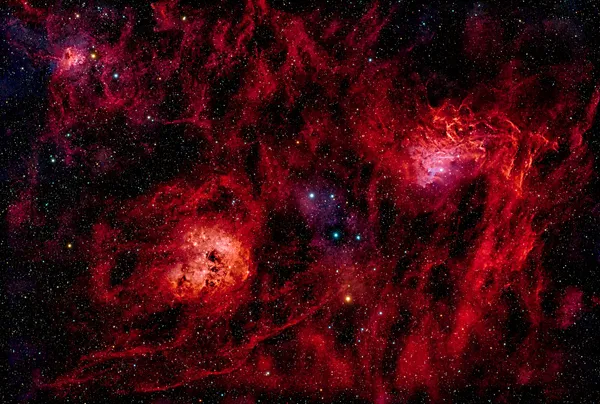 1,500 ly distance
A runaway star lighting up the gas cloud it's racing through
1,500 ly distance
A runaway star lighting up the gas cloud it's racing through
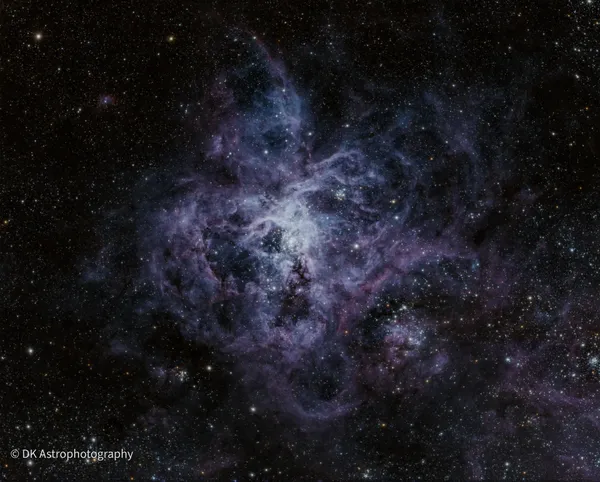 161,000 ly distance
The most luminous nebula in the Local Group of galaxies
161,000 ly distance
The most luminous nebula in the Local Group of galaxies
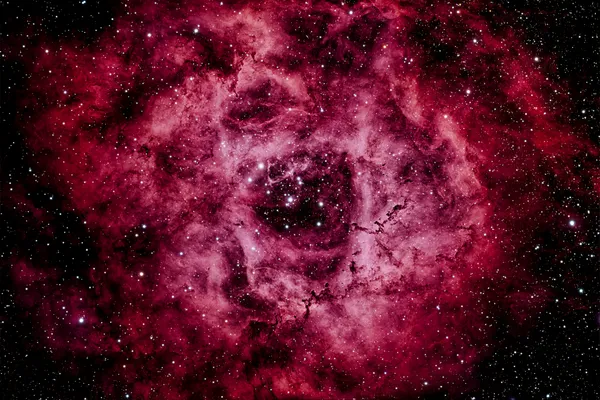 5,200 ly distance
A flower-shaped cloud of gas sculpted by fierce stellar winds
5,200 ly distance
A flower-shaped cloud of gas sculpted by fierce stellar winds
Comments